Showing posts with label IC-705. Show all posts

Monday, January 23, 2023

Video: Checking (and comparing) receiver sensitivity with tinySA ULTRA

Soon after the original tinySA was offered, I made a video showing how to make an MDS measurement of a receiver by using the tinySA in 'Signal Generator' mode. But with the tinySA's minimum output being -76dBm (almost S9), a lot of external attenuation was required to get the signal within range of typical MDS values.

The new tinySA ULTRA has a minimum output of -123dBm, making it much easier and less expensive to make the same test. And with less clutter since less external attenuation is needed - actually, none, other than the step attenuator you'll need anyway.

You can see the original video here.

A former co-worker of mine verified the output level accuracy of my tinySA ULTRA with an HP power meter and found it to be within 1dB of its indicated value on HF down to -100dBm. After that, inaccuracy increases to 3dB at -123dBm.

So, with the output set to -100dBm, and a 0-62dB step attenuator, I did a quick by-ear comparison of my new Index Labs QRP+ to my IC-705.

Tuesday, November 15, 2022

Tale of two spectrum analyzers: tinySA vs. Rigol DSA-815, looking at IC-705 IMD

After yesterday's IMD measurements of the (tr)uSDX, I decided to have a look at the IC-705's IMD characteristics with two spectrum analyzers: a Rigol DSA-815 and the tinySA.

More than anything else, this comparison seems to help justify the purchase of the upcoming tinySA ULTRA - not that I need much help in that department.

As expected, third order IMD of the IC-705 was about 30dB down from the injected frequencies on both SA's, but...

...with the lowest resolution BW of the tinySA being only 3 kHz, it was unable to distinguish the RF representation of the two audio frequencies, seeing them only as one signal rather than two signals 1200 Hz apart (700 & 1900 Hz).

Saturday, December 11, 2021

A perspective on taking expensive rigs outdoors

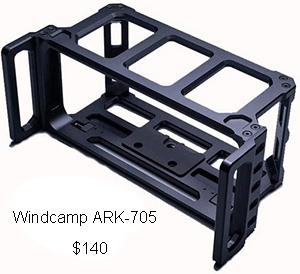
And the Peovi brand is $135
Every now and then I see a posting from someone with a radio like the IC-705 who is hesitant to take it outdoors due to the "cost of the radio".

If they do take their expensive radio to such a harsh locale, they first must take the precaution of embedding it into a metallic frame that adds to the inconvenience of operating the radio and makes it a bit less portable - but provides the illusion of protection.

I suppose some actual protection is offered if the unlucky IC-705 owner is considerate enough to drop the rig in such a way that it hits the ground in the correct orientation.

On my recent trip to Colorado I met a lot of other people who, like me, were there specifically to photograph the beautiful scenery. Many of us had traveled from other states. None had cheap cameras.

Sunday, June 20, 2021

Retractable feet for the IC-705


At the suggestion of Jim KK1W on the IC-705's group.io forum I placed an order for "Laptop Cooling Feet" to be used as a way to provide a bit of much-needed tilt to the posture of my IC-705.

The item was delivered the next day and seems to be of high enough quality to do the job and last a good while. 3M adhesive pads are used to afix the legs to the IC-705's underside.

The only variable to consider is tilt amount vs. stability. Too far forward and the stability is at its max but the tilt amount is quite small. Too far back, the stability is such that the IC-705 almost wants to somersault forward.

I place the feet as shown and am happy with the improved visibility offered by the tilt - and the '705 is rock solid on the desktop.

As can be seen, the feet are retractable and the '705 fits into both the Icom backpack and the Pelican-like hardcase I have for it, just like before. 


At $10, it's hard not to like.

.

.

Saturday, April 24, 2021

MDS measurement of IC-705

Gigatronics 2420M sig-gen with 40 dB of attenuation on output

A Gigatronics 2420M just back from being calibrated baited me with its freshly-attached green 'PASSED" tag. We use these heavy pieces of gear at frequencies much higher than the IC-705's range so I was curious to put the two together at HF to 433 MHz and see what the results might be.

Saturday, March 13, 2021

Video: The Belka-DX micro-receiver on external antennas

Apologies for the lackluster editing. I chose content over form, hoping to provide a glimpse of what it's like to tune around the bands with this little radio hooked up to something other than the small whip antenna that comes with it.

The high bands, as we know, have been circling the drain for a while now - not much there that I could find - so this is an "AM broadcast band to 14 MHz" test on CW, SSB and AM.

The rest of the video's description is given in the opening 15 seconds. The lighting gets better (a relative term) 3 minutes in.


.

.

Wednesday, March 10, 2021

БЕЛКА-DX

Codewheel not included!
 

The Belka-DX arrived here about three weeks ago from Minsk, Belarus. It is an updated version of the Belka-DSP, both of which were designed by Aleksandr Buevkiy EU1ME. The photo above was inspired by the "spy radio" theme of a review of the older Belka-DSP (link below).

About the price: if you want one of these diminutive and highly capable receivers, you'll have to decide which of three prices you want to pay. At the time of this posting:

All three options include shipping.

I chose Door Number 3, the Belrig option.

Evidently, some people are uncomfortable using their VISA card for international transactions. I have confidence that my bank will support me and therefore had no such worries. My opinion of PayPal (which isn't available in Belarus) is such that I much prefer using my credit card over using PP anyway.

I received my Belka-DX in 11 days. A tracking number was provided one day after I placed the order and I was able to track it from Minsk to New York to Houston.

Sunday, March 7, 2021

Measuring MDS with TinySA, RMS multimeter and attenuators

The popularity and low price of the nanoVNA and TinySA devices allow hams and other radio hobbyists to make measurements that were out of reach just a few years ago due to the expensive equipment required.

For those who have a TinySA, you not only have a spectrum analyzer - you also have a surprisingly accurate signal generator.

With a series of attenuators, a TinySA, RMS multimeter and some cabling, I had all I needed to make an uncalibrated MDS measurement of my radios. Maybe you do too. Here's how to do it.