Showing posts with label kits. Show all posts

Wednesday, May 6, 2026

KXUSBC2 installed into KX2

13 May: Updated info, including notes from its designer, Manuel HB9DQM. 

I received my KXUSBC2 in the mail today and wasted no time installing it into my KX2.

No soldering or de-soldering was required. Other KX2's may or may not require a small amount of soldering, depending on when the it was manufactured.

Those contemplating the addition of the USB-C charger to their KX2 should read the instructions here

If you're replacing Elecraft's built-in charger, the KXUSBC2 retains Real-Time Clock functionality. 

Wednesday, February 25, 2026

KX2's internal battery capacity when charged from different voltage sources - and a new product for the KX2

The manual for the KX2's internal battery charger (KXIBC2) allows for a variety of input voltages, up to a maximum of 15V, to be used to charge the radio's 2.6AH lithium battery. The manual also mentions that lower voltages (down to 11V) can also be used although the battery will not be fully charged at these voltages.

I was curious to see how a lower charging voltage - ie, a partial charge - would correspond to capacity.

My main interests were:

  • If I charge the KX2's battery from my motorcycle's lead-acid battery, how much capacity will it have?
  • If I charge a completely discharged KX2 battery from the motorcycle, will I still have enough juice in the motorcycle battery to be able to start the bike?

Tuesday, February 3, 2026

Hilltopper Tallboy: Building, aligning, testing and on the air


I've had a hankering to build something lately and happened across a relatively new offering from the 4 States QRP Group: the Hilltopper Tallboy, a monoband QRP CW transceiver kit.

Available for 15 to 40 meters (and maybe 60m soon), I ordered a 20m version. It arrived 5 or 6 days later and I started building it right away.

The Build 

The kit's contents were well organized as were the accompanying instruction.

Parts are sorted into one of 10 bags and the assembly follows the bag's numerical sequence. There are exceptions to this as parts are sometimes required from the ESD bag or the bag containing the matched crystals.


The largest bag - and the one responsible for my initial impression of "Man, that's a substantial kit!" - is the one containing the mechanical components: knobs, jacks, hardware, etc.

Tuesday, December 3, 2024

Video: QMX+ receiver sensitivity comparison with KX2, FT-891


Receiver sensitivity of the QRP Labs QMX+ is currently being discussed on the QRP Labs forum with at least one member of the group is disappointed that the MDS value of the QMX+ isn't published.

With the QMX+ being a kit, any published value of MDS would have to be a range of fluid values since receiver characteristics will depend, not only on component tolerance deviations, but of builder's methods in soldering and the winding of toroids & transformers.

I decided to compare my QMX+ receiver sensitivity with the KX2 and FT-891, using a TinySA Ultra and appropriate attenuation.

As can be seen in the video below, the QMX+ does quite well.

After the video, I "measured" (by ear) the point at which a signal becomes too weak to copy on the other bands. The CP1 directional coupler does not cover 6 meters but I measured -113 dBm on that band, which is probably inaccurate. I will sweep the coupler on 6m with my VNA and post a corrected value soon.

Directly on YouTube


.

.

Monday, November 18, 2024

Video: As much DX as domestic! POTA with the QMX+

The Crystal River area of west-central Florida contains several POTA sites within a small area. Crystal River Preserve State Park is my favorite for activations due to the covered picnic table and proximity to manatee-rich waterways.

Kayaks can be rented at the park but my purpose today was to exercise the QMX+ on the high bands and the bands did not disappoint. Contacts were made on all 5 bands 10-20 meters, including a good amount of EU DX and one station in Chile.

Several people have told me that previous videos that include text overlays of the callsigns being heard are helpful so I've included those in the video below. CW speed of myself and most callers is around 22 wpm.


Directly on YouTube


.

.

Friday, September 27, 2024

QRP rigs, pricing, and what's missing from most of them


A search of the mythical Ideal QRP Travel Rig For Vibration-Rich Environments has me, once again, pondering what's out there and coming to the same old conclusion:

That the Elecraft KX2 - manyyears (yes, one word) after its introduction - still has no peer. Eight years old now - a virtual eternity.

Like others, I watch the YouTube infomercials of the latest offerings, hoping to find my unicorn. But lately, rather than compelling me to open my wallet, they reaffirm the value of the radio released back in 2016.

Here's where I'm coming from vs. what's out there - a bit of a backstory (please bear with me):

Nine years ago, I rode most of the off-road motorcycle trail known as the TAT that stretched (at the time - it's longer now) from Tennessee to Oregon, on a single-cylinder Suzuki DR650. Single-cylinder bikes are often called "thumpers" for good reason. I made it to Utah before the obligations of still being employed called me home. That fact bugs me like you have no idea. I almost finished - but didn't.

I had two radios with me: an MTR-3 and an Elecraft KX2. Both performed admirably and survived single-cylinder vibration and the bike being dropped three times on Colorado's Ophir Pass.

Monday, June 24, 2024

Update on my new Hermes Lite 2

A few people expressed interest in the HL2 that I mentioned a few weeks ago - two of those were CW ops who want to know how it does on that mode.

To improve its performance on CW, I ordered the mod kit which converts the rig to a Plus model.

The mod kit was sent out by WA2T the very day I ordered it but it arrived after we'd left for Iceland and has been with our neighbor since then. We are home now, but our neighbor is out of town!

She returns later this week, but we leave again for three weeks a few days after her return.

Now that you've suffered through all that, the short story is - I won't know how the Plus version of the HL2 performs on CW until late July.

But in the meantime, I've been using the HL2 on a daily basis on digital modes. Mostly FT8 with a bit of WSPR thrown in, and I'll say this - I love this radio! Talk about "bang for the buck..."

The HL2 with Thetis and WSJT-X software was a cinch to set up. I am no longer missing my old Apache Labs or Flex rigs. That weird, tough-to-explain satisfaction that comes from having a radio totally controlled by a PC - and all the functionality and flexibility therein - is in complete attendance with the HL2.

I don't yet own a mic for the HL2 but the comments on Pure Signal fidelity by those who do have piqued my curiosity on even my least-favorite of modes, so I'll give it a Go, eventually.

On FT8, the radio performs well, which is to say that a super-strong signal appearing on the waterfall does not diminish the presence of weaker stations.

More later on this amazing radio, but it'll be a while.

For now, I'll go out on a limb and say this: If you're an op who likes digital modes and wants a high-performing radio that won't break the bank, the Hermes Lite 2 needs to be on your Short List.

.

Other options in the same price range:

Square SDR (page is in Czech but Google's Chrome browser will translate it)

A 6-160m near-equivalent to the HL-2 from EU1SW

I have no experience with either of these but comments from users on both a quite favorable.

.

Friday, March 22, 2024

A few thoughts on the QMX transceiver


A recent get-together of Central Florida POTA ops, led, of course, by Bill N4NYM, allowed me the opportunity of meeting a dozen or so kindred spirits at Lake Louisa State Park where I very much enjoyed seeing their set-ups and eating their food.

One of those in attendance was a newbie CW op, Glenn KO4NTA, and somehow Glenn and I got to talking about QRP. He had several rigs with him but the radio he most wanted to show me was his new Army-green (tr)uSDX.

"It costs about $100, covers 5 bands and is super tiny!"

That very statement - since it applies equally - got me to thinking about my inbound QMX, and I asked Glenn if he'd heard of it.

To my surprise, he had not heard of QRP Labs at all.

At that point, I think I may have unwittingly become a bit of a salesman. Glenn had not yet been on the air with his (tr)uSDX and I had not yet been on the air with a QMX. I do have a (tr)uSDX though, and have made a number of hard-won contacts with it on both CW and SSB.

I know the shortcomings of the (tr)uSDX and, now that I've made almost 100 contacts (and two POTA activations) with my new QMX, I have a pretty good idea of where it stands in the $100-Rig Department.

Thursday, December 15, 2022

Doping toroids

Back in the olden days, when kits were plentiful and freshly-made products from Small Wonder Labs, OHR, Norcal and KD1JV filled the air, a common question was "Should I dope the toroids?"

By which they mean, should the coils be secured to the board - and/or the windings to the core - with a small dab of clear fingernail polish?

Even then, before POTA, many QRPers enjoyed taking their rigs on hikes or backpacking trips and were concerned about the possiblity of jostling a toroid out of whack (a technical term). After all, they are a fairly significant mass to be held in place with two tiny (at times) 26g connections.

Answers varied but were mostly in favor of not doping them. I don't blame the kit vendors for offering this advice - can you imagine the headache of a kit builder, doping a coil into place and then learning that it contained one winding too many? Better to not dope them and retain the ease of removal/adjustment.

The stated reason for not doping them was that the fingernail polish would change the characteristic of the coil?

Some of my commercial gear does have doped toroids - the FT-891, for example. Meant to be used in a mobile environment, it makes sense. Of course, Yaesu is certainly compensating for any possible change in a coil's inductance by taking the effect into account with the coil's initial construction.

With a few redundant LP filters on hand - and a possible bicycle ride over bumpy terrain this spring, QRP rig stowed - I decided to see what the effect would be.

Sunday, November 13, 2022

Video: transmitter IMD of (tr)uSDX

Updated 14 Nov (see bottom of page)


Kevin KB9RLW has posted an interesting series of videos to YouTube recently, exploring the poor SSB performance of his (tr)uSDX transceiver (beginning with this one).

I'm primarily a CW operator and wasn't too concerned about my (tr)uSDX's SSB performance but Kevin's video's piqued my interest and I decided have a look with my SA and an Elecraft Two-Tone Generator feeding a 700 Hz and a 1900 Hz tone into the mic input of the (tr)uSDX.

The purpose of this test is to measure IMD due to non-linearities in the transmitter. In a perfect world, only those two tones would be transmitted.

Friday, October 7, 2022

FT-891 Powerpole conversion

A few days ago YouTube featured a video showing a method of converting the Molex power plug on a Yaesu FT-891 to an Anderson Power Pole.

Since most of my gear uses this type of DC connector it made sense to add the FT-891 to the list.

It also greatly reduces the mass of wire that I didn't need but was hesitant to cut in case I ever decide to sell the rig.

I use the FT-891 both stationary mobile and portable and need different wire lengths for each.

Having Power Poles simplifies the the usability of the rig in terms of powering it from one application (mobile, portable) to the next.

Thursday, June 2, 2022

Finally - a decent step attenuator kit

I've gone through several step attenuators in the last two years, both kits and built units. I was unhappy with them all for one reason or another and got rid of them.

Most weren't in a metal housing - a must for such a device when used at RF - and weren't worth the trouble to install into such a housing due, usually, to cheap, flaky buttons that created more (or less) attenuation from one press to the next.

Thanks to a recent review in QST Magazine for an unrelated kit, I've finally found a good quality step attenuator.

With a metal housing.

And toggle switches.


The review in QST was for a two-tone generator from HecKits. I have no need for a 2TG but a look at HecKit's website turned up the attenuator I'd been looking for.

Monday, February 21, 2022

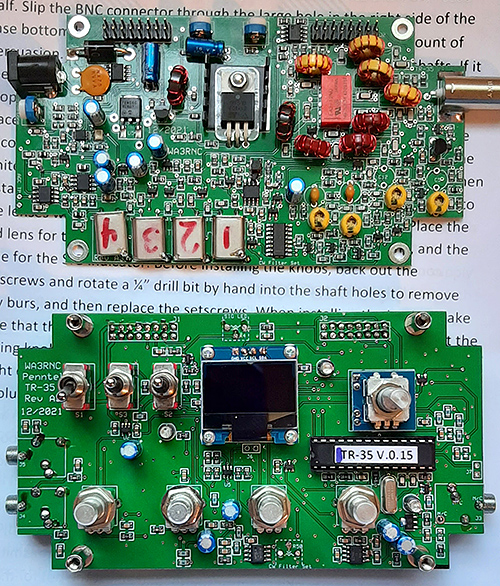
Thoughts on the Penntek TR-35 QRP transceiver kit

Boards completed. Plenty of room for easy assembly

UPDATE: The TR-35 is reviewed in the December 2022 issue of QST. 

                  .

I've only had the Penntek TR-35 exactly one week, but during that time I've:

and had many ragchews (and park huntings) on all four bands. I've also made selectivity, spectrum and MDS measurements.

Be forewarned - the following may sound like an advertisement, but it is not. I paid full price for the kit and have had no other communication with the kit's designer, John WA3RNC.

Now that that's out of the way, here is a fleshing-out of the notes I took during the week.

The Build

In 40 years of building kits, I've never seen one that is designed to prevent potential problems to the extent of the TR-35.

First off, the kit arrives about 70% pre-built and pre-aligned. Numerous SMD components are already installed and even the tedium of parts inventory has been rendered as mostly unnecessary due to how the parts are packaged. They come in three sleeves - one for each of two boards, plus the final assembly components (knobs, jacks, plugs, etc).

Within each sleeve, the components for each assembly step are each in their individual pocket. There are anywhere from 1 to 5 components per pocket.

Tuesday, August 24, 2021

A week with the Mercury III S amplifier


If you left an Ameritron AL-80B and an Elecraft KPA-500 in a room together with some wine and soft music, the Mercury III S might be the result. Like the KPA-500, it is solid state and therefore broadbanded - no tuning up is necessary. And, like the AL-80B, it outputs a kilowatt (actually, 1200 watts) and uses a relay for T/R switching.

I've owned both the Ameritron and the Elecraft amps, so the new Mercury feels a bit like a hybrid of both, though it is nothing of the sort.

I assembled the Mercury on the same day it arrived. What initially looked to be a two-evening process took only 5 hours, and that was taking my time. All the parts, patch cables, connectors and hardware went together easily and I think this would make a great first kit for someone.


It was a far easier build than anything else I've ever built and, upon completion, there is no alignment - just a few checks with an ohm meter to make sure various sections aren't shorted to ground.

Rather than a narrative, some brief notes and then some numbers.

Friday, October 9, 2020

Harmonic content of mcHF's output


From time to time I've read comments on various forums that mcHF transceivers should not be used with amplifiers because of the high harmonic content on the output.

I almost always use an amp with mine when operating from home so I decided to measure my  mcHF. My amp, a Hardrock-50, contains its own lowpass filters on the output so I was never concerned with whether or not the mcHF was "dirty".

Here are the results, made with a recently (July 2020) calibrated HP-8563A spectrum analyzer.

Each horizontal line represents 10dB. So the top line, where the fundamental is placed, is the reference or 0 dB. The next line down from that is -10dB, then -20dB, etc.

I've put a delta marker on the first harmonic and it's easy enough to count down from the top of the display to see the attenuation of subsequent harmonics, keeping the 10dB per line in mind.

Friday, September 25, 2020

Building the Emtech ZM-2


Although not a transceiver, I consider the Emtech ZM-2 a QRP classic. Years ago, Emtech did sell transceiver kits - the NW20, NW30 and NW40.

I never built any of their transceivers but I did build a ZM-2 tuner long ago. At the time, they only offered SO-239 connectors and mine always had SO-239 to BNC adapters on it to accommodate the rigs I used with it. Also, my construction in those days left a bit to be desired...it was time to build a new ZM-2.

ZM-2's are now available in kit form or already-built, with BNC's or SO-239 connectors.

Over the years, I've come full circle on the topic of internal autotuners - at first, preferring them - vs. outboard manual (or auto) tuners. The KX2 was the first rig I had with an internal autotuner and I loved its convenience. With other QRP rigs, I used Elecraft's outboard autotuner, the T1. So I sold my original ZM-2.

Wednesday, December 11, 2019

Eutectic or non-eutectic solder - does it matter?

The question should have occurred to me a long time ago:

Why are the tin/lead ratios of two common solder mixes so close? Surely there can't be that much of a difference in the melting point of 60/40 versus 63/37.


Answer: It's not about the melting temperature - and don't call me Shirley.

There are only 5C degrees of difference in the melting temperatures of these two ratios. But there is a very significant difference in how they melt and in how they re-solidify. I've been unaware of this until recently.

Monday, October 2, 2017

Kit: TinySWR - a truly small SWR indicator

Designed by a group of German hams (DF3OS, DJ6TE, DL9SCO and DK3IT), the TinySWR measures 0.6 X 0.8 inches square and was made to be installed inside of rigs like the KD1JV Sprints (in Altoids tins) and other super small QRP rigs.