Showing posts with label FT-891. Show all posts

Monday, August 17, 2026

W7, VE7 ops...and booking ahead for ZA

We've arrived at cooler temps and have been at our AirBnB for several days now, located between Courtenay BC and Strathcona Provincial Park. We see snow on the mountaintops from our balcony - what a concept!

Mount Rainier was our last stop before taking the ferry over from Port Angeles WA to Victoria BC.

We did a 4 mile hike there and came face to face with a black bear heading  our way on the trail. We walked away from it slowly, it did the same. I walked backwards and opened my phone's camera app and made a brief video as the bear paralleled us on the other side of a small creek.

Yesterday consisted of a beautiful 7 mile hike in Strathcona PP followed by a frustrating activation. Were band conditions poor or does being surrounded by mountains adversely affect propagation?! 10 tough, well-earned contacts went into the log, all of them weak.

Later today we are headed to a beach where I'll see if saltwater offers an improvement in radio'ing. We'll be at Miracle Beach Provincial Park CA-3807 sometime between 1900-2200Z and may go to another nearby beach (and POTA site after that).

Wednesday, December 18, 2024

A most unusual POTA activation

Scarecrow and Blue
 

I left the house early yesterday morning, driving north about 70 miles to the Suwannee River (Florida), whose shores contain a string of POTA sites.

They're back!
My destination was US-10594, known among civilians as Manatee Springs South State Conservation Area. This is distinct from Manatee Springs State Park just up the river.

The State Conservation Area became, for me, a State Conversation area, both on the air and off.

I arrived at about 8:30 am local time, not knowing what to expect in the way of amenities like picnic tables, BBQ grills or other devices whose true purposes are to support radios and antennas.

What's there is this: two picnic tables covered by a roof, located adjacent to the river at a canoe/kayak launching site.

One of the tables was occupied by a scruffy-looking man and his scruffier-looking white dog named Blue. Pulled up onshore was a loaded-for-bear kayak.

We said our hellos, then got to our "whatcha-doin's?".

Tuesday, December 3, 2024

Video: QMX+ receiver sensitivity comparison with KX2, FT-891


Receiver sensitivity of the QRP Labs QMX+ is currently being discussed on the QRP Labs forum with at least one member of the group is disappointed that the MDS value of the QMX+ isn't published.

With the QMX+ being a kit, any published value of MDS would have to be a range of fluid values since receiver characteristics will depend, not only on component tolerance deviations, but of builder's methods in soldering and the winding of toroids & transformers.

I decided to compare my QMX+ receiver sensitivity with the KX2 and FT-891, using a TinySA Ultra and appropriate attenuation.

As can be seen in the video below, the QMX+ does quite well.

After the video, I "measured" (by ear) the point at which a signal becomes too weak to copy on the other bands. The CP1 directional coupler does not cover 6 meters but I measured -113 dBm on that band, which is probably inaccurate. I will sweep the coupler on 6m with my VNA and post a corrected value soon.

Directly on YouTube


.

.

Monday, February 6, 2023

The utility of Elecraft's CP1 bi-directional coupler with the tinySA

Set-up for measuring spectral output of 100W rig. Note the 100W dummy load behind the tinySA

This is an example of where the availability of a new item adds value to something that's been around a while. The new item is the tinySA - many hams now have one of these small spectrum analyzers/signal generators - and the old item is Elecraft's CP1 bidirectional coupler.

Questions I get whenever I post something related to the tinySA are:

  • Can I use it with non-QRP equipment?, and
  • How do I measure a transmitter's output to make sure I don't exceed the tinySA's 6dBm (4mW) max input?

I decided to use my tinySA ULTRA to measure the spectral output of my Yaesu FT-891 when operated at full power: 100 watts.

Monday, November 28, 2022

Two POTA's in NJ

The road to the Stokes Forest campsites
After many, many years, I finally returned to New Jersey for a brief visit. I lived there (in West Milford) post-Navy while seeking a job in Texas that eventually, thankfully, came through.

New Jersey is a study in contrasts and I lived there long enough to see a fair amount of them.

One set of contrasts exists between the two POTA's - one beautiful; the other, industrial - and I activated them both. What they each have in common is a drive-up-able overlook, perfect for RF radiation to all parts of the world.

The rig in both cases was the trusty, ever-reliable FT-891 powered by a 12AH battery. The antenna was MFJ's 17-foot whip screwed into a magnet mount on top of the car. Simple, effective and quick to set up.

The first POTA was from beautiful and peaceful Stokes State Forest K-4999. Specifically, from Sunrise Mountain.

Peak fall color, as I recall from eons ago, is mid-October. I missed that but enjoyed the view outside the windshield regardless. It's not uncommon to see turkey and black bear in this park but I saw neither today.

I hiked around a bit, going down Memory Lane, recalling the specific locations of past outdoor QRP ops way before POTA and NPOTA.

Friday, October 7, 2022

FT-891 Powerpole conversion

A few days ago YouTube featured a video showing a method of converting the Molex power plug on a Yaesu FT-891 to an Anderson Power Pole.

Since most of my gear uses this type of DC connector it made sense to add the FT-891 to the list.

It also greatly reduces the mass of wire that I didn't need but was hesitant to cut in case I ever decide to sell the rig.

I use the FT-891 both stationary mobile and portable and need different wire lengths for each.

Having Power Poles simplifies the the usability of the rig in terms of powering it from one application (mobile, portable) to the next.

Thursday, March 17, 2022

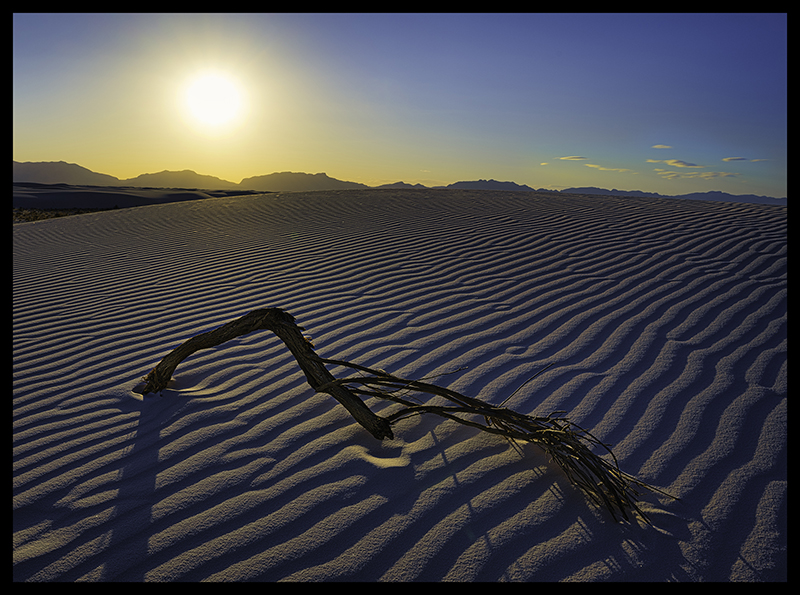
White Sands National Park K-0970

Alamogordo, NM is 17 steep downhill miles and a 4000' descent from our Cloudcroft QTH - therefore, no liquified dinosaur bones are required to propel our car into town. Coming back up is another matter.

Just west of Alamogordo is White Sands NP - a sea of white gypsum, not sand - in a brown landscape. Sunglasses are recommended required.

The gypsum is of a very fine texture and is quite unlike beach sand. Being completely dry, it has no adhesive qualities at all, so it doesn't stick to the skin. Not even a little. It also doesn't absorb heat. After hours of direct desert sunlight, it remains cool to the touch.


After driving the park road and making some exploratory excursions among the dunes for future photographic possibilities, I attached the Hamstick to the car, plugged the battery into the FT-891 and started calling CQ.

Sunday, August 1, 2021

The new POTA rig goes DXing

20m HamStick

My old-school way of activating parks is more fun and I'll continue to operate that way. But, for some locations, shooting a slingshot and fishing line into a tree is gonna draw attention - and sometimes, that's negative attention.

And some places have no convenient trees. Such was the case on my recent trip to Colorado.

The new method is with my resurrected FT-891 and Bioenno 12V 12AH battery. I have HamSticks for 17, 20, 30 and 40 meters. Today's test went well and I learned that:

  • the FT-891 sucks the juice out of a battery so rapidly that the barometric pressure along the Gulf Coast dropped by 20 millibars.
  • a 40m HamStick has a 2:1 SWR bandwidth of only 100 kHz. This means either CW or phone - not both.
  • the FT-891 is a good (not great) CW rig when set up as per N4HNH's video

The benefit: I can operate anywhere that I can park and draw no attention. The disadvantage: no  one comes over to inquire and get a demo of ham radio.

I've gotten into many conversations while operating from picnic tables, some of which resulted in email exchanges with links to the ARRL and other "What is ham radio all about?" types of websites. That won't happen anymore.

This new (for me) type of operation trades the personalization of ham radio for a greater number of places from which to operate and the ability to more quickly get on the air.

This morning I was tuning the 20m HamStick for lowest SWR on CW and heard a very strong CQ. I was very surprised when I heard the callsign: JE1RZR, calling from Tokyo - 7000 mi/11,200 km away. I was even more surprised when Manabu answered me.