Showing posts with label CW. Show all posts

Friday, October 16, 2026

Interesting QSO's with QRPp'er Alexey RT7O

ZA/AE5X
While making several activations of Alpet e Shqipërisë National Park (AL-0001) in northern Albania earlier this week, I had a total of three QSO's with Alexey RT7O. Each time, Alexey used a different QRPp rig.

A pleasant series of emails followed over the next couple of days as Alexey described and sent photos of the radios he used - all of which he homebrewed.

The receiver in each case was a Malamute transceiver and its antenna consisted of two 41-meter wires running down from a balcony (set at a 90-degree angle to each other) and sloping down toward a tree and a pole.

The transmitting antenna for the rigs described below was a 14 MHz sloper aimed westward.

In my case, the rig in use was a QRP Labs QMX putting 6 watts into a 1/4-wave whip attached to a magnet mount on the roof of my rental car. No ground radials.

I was surrounded by mountains on all sides and didn't know what to expect of my ability to make contacts from an area with no unobstructed horizon in any direction. To my surprise, contacts came fast and furious thanks to the ZA prefix. 

All QSO's were on 20m CW. 

For our first QSO, Alexey was using a  700 mW transmitter - built with two rod tubes - to mark the "First Earth Satellite" activity event:

.


.


.

An audio recording of this QSO is here (I was using a QMX). 

. 

For our next QSO's Alexey used the absolutely beautiful 300mW designed around an old Soviet 6P15P tube. The schematic is shown here:

Friday, October 9, 2026

Activating AL-0001 with the QMX - and a bit of drone flying

Last year, Hans G0UPL rushed me a QMX at my request so that I could operate during an impromptu trip to Vietnam. As it turned out, it was impossible to get permission to operate and I've felt guilty ever since at having taken advantage of Hans' willingness to expedite the QMX.

But as of today the QMX has finally gone on a bit of a DXpedition.

I am currently near Theth Albania and have just returned from activating the unpronounceable-by-me Alpet e Shqipërisë National Park with the QMX.

The entire operation was on 20m CW. I was surrounded by mountains but was able to easily work a good number of Europeans and one US station (K2UPD) in New York. 

The QMX performed well.

I hope to activate the same park from another (better) location tomorrow.


Interesting contacts with QRPp'er Alexey RT7O - click here.

.

. 

Thursday, August 27, 2026

October: ZA/AE5X update

I've been getting a few emails asking for more info on our upcoming trip to Albania.

Thanks to Col at DX World for the image and to Bernie at the Daily DX - and to both of them for publicizing this holiday style operation that will begin in October.

I'd like to emphasize that this is a vacation, not a DXpedition. All radio ops will be a bit on the spur-of-the-moment but I will be able to pre-announce them on my blog and the POTA website a couple hours beforehand.

 
Rig:

Tuesday, February 3, 2026

Hilltopper Tallboy: Building, aligning, testing and on the air


I've had a hankering to build something lately and happened across a relatively new offering from the 4 States QRP Group: the Hilltopper Tallboy, a monoband QRP CW transceiver kit.

Available for 15 to 40 meters (and maybe 60m soon), I ordered a 20m version. It arrived 5 or 6 days later and I started building it right away.

The Build 

The kit's contents were well organized as were the accompanying instruction.

Parts are sorted into one of 10 bags and the assembly follows the bag's numerical sequence. There are exceptions to this as parts are sometimes required from the ESD bag or the bag containing the matched crystals.


The largest bag - and the one responsible for my initial impression of "Man, that's a substantial kit!" - is the one containing the mechanical components: knobs, jacks, hardware, etc.

Sunday, November 30, 2025

CQWW-CW from an HOA; Anan-10E vs. Hermes Lite 2+


I went into the contest with the goal of testing the performance of the HL2+ in crowded CW conditions.

Rather than writing a dry narrative of "How I spent my weekend" (actually only four hours of it), I'll just sum it all up in bullet points:

Monday, November 18, 2024

Video: As much DX as domestic! POTA with the QMX+

The Crystal River area of west-central Florida contains several POTA sites within a small area. Crystal River Preserve State Park is my favorite for activations due to the covered picnic table and proximity to manatee-rich waterways.

Kayaks can be rented at the park but my purpose today was to exercise the QMX+ on the high bands and the bands did not disappoint. Contacts were made on all 5 bands 10-20 meters, including a good amount of EU DX and one station in Chile.

Several people have told me that previous videos that include text overlays of the callsigns being heard are helpful so I've included those in the video below. CW speed of myself and most callers is around 22 wpm.


Directly on YouTube


.

.

Friday, September 27, 2024

QRP rigs, pricing, and what's missing from most of them


A search of the mythical Ideal QRP Travel Rig For Vibration-Rich Environments has me, once again, pondering what's out there and coming to the same old conclusion:

That the Elecraft KX2 - manyyears (yes, one word) after its introduction - still has no peer. Eight years old now - a virtual eternity.

Like others, I watch the YouTube infomercials of the latest offerings, hoping to find my unicorn. But lately, rather than compelling me to open my wallet, they reaffirm the value of the radio released back in 2016.

Here's where I'm coming from vs. what's out there - a bit of a backstory (please bear with me):

Nine years ago, I rode most of the off-road motorcycle trail known as the TAT that stretched (at the time - it's longer now) from Tennessee to Oregon, on a single-cylinder Suzuki DR650. Single-cylinder bikes are often called "thumpers" for good reason. I made it to Utah before the obligations of still being employed called me home. That fact bugs me like you have no idea. I almost finished - but didn't.

I had two radios with me: an MTR-3 and an Elecraft KX2. Both performed admirably and survived single-cylinder vibration and the bike being dropped three times on Colorado's Ophir Pass.

Friday, June 21, 2024

Video: Iceland by drone and operating as TF/AE5X


I am amazed at the stunning scenery of Iceland - the trip was bucket-list incredible.

The video below is about 2/3 drone video (followed by 1/3 radio) of the places we saw as we drove around the country.

In all, we put 950 miles (1500km) on the car and I activated 4 parks. Each park was a first-activation for that park. I had no trouble making contacts but my time at each park was limited. The KX2 at ten watts into a roof-mounted vertical worked well and was portable enough to travel with easily.

Thursday, June 13, 2024

Today's park activation from Iceland

I've activated two parks in Iceland since arriving 4 days ago - both times were first activations for those parks. It's been tough to put the camera down. Iceland is an amazing country and I'll have more to say about it later.

Today's activation of IS-0092 Blábjörg Natural Monument was a lesson in Exceeded Expectations 101. Just when you think you can predict certain aspects of this radio stuff, the unexpected happens.

The park is located near the small town of Djúpivogur on Iceland's eastern coast. It's pretty much a straight shot into parts of Europe but many mountains block the path to the US...or so I thought.

I called CQ POTA on 15, 17 and 20 meters and worked both continents on all bands.

Many US stations were quite strong and I worked a number of familiar calls. The QRN that I worried about was non-existent - the bands are quite, propagation over salt water works like a charm and my 10 watts was doing the trick.

Friday, March 22, 2024

A few thoughts on the QMX transceiver


A recent get-together of Central Florida POTA ops, led, of course, by Bill N4NYM, allowed me the opportunity of meeting a dozen or so kindred spirits at Lake Louisa State Park where I very much enjoyed seeing their set-ups and eating their food.

One of those in attendance was a newbie CW op, Glenn KO4NTA, and somehow Glenn and I got to talking about QRP. He had several rigs with him but the radio he most wanted to show me was his new Army-green (tr)uSDX.

"It costs about $100, covers 5 bands and is super tiny!"

That very statement - since it applies equally - got me to thinking about my inbound QMX, and I asked Glenn if he'd heard of it.

To my surprise, he had not heard of QRP Labs at all.

At that point, I think I may have unwittingly become a bit of a salesman. Glenn had not yet been on the air with his (tr)uSDX and I had not yet been on the air with a QMX. I do have a (tr)uSDX though, and have made a number of hard-won contacts with it on both CW and SSB.

I know the shortcomings of the (tr)uSDX and, now that I've made almost 100 contacts (and two POTA activations) with my new QMX, I have a pretty good idea of where it stands in the $100-Rig Department.

Tuesday, November 21, 2023

DXing: KX2 masquerading as a KH1

A cheap 51" (130cm) telescoping CB walkie-talkie antenna and conditions on 10-15 meters gave me the idea to treat my KX2 like a KH1.

Tuesday mornings can offer slow POTA activity but I was pleased with the results anyway from a peaceful little park about half an hour from home.

The weather was perfect and this project served as the perfect excuse to be outside.

In the following video, I made 10 contacts in 20 minutes. Those 10 contacts included 7 DXCC entities - all with a short whip antenna and a single ground radial.

When the bands are hot, amazing things are possible. Earlier this week I was able to work 4W8X on 10m CW from home with the KX2.

This weekend I'll be building a short coil to supplement the CB whip's internal coil with the idea of using the whip on 17/20 meters.

Various online calculators say I'll need 30 turns on a 1-inch form.


YouTube

.


.

.

Friday, April 28, 2023

9A5N solid-state paddles

Seven or eight years ago, I built a capacitive-touch keyer from a kit offered by a vendor no longer in business. The keyer was small enough to be built into an existing rig - the "paddles" were simply two small bolt heads that extended through the rig's case.

Touch one bolt to send dits, the other for dahs.

To see other examples of this implementation, check out this site.

A similar kit can be found here.

For a long while now, I've had my eye on the solid-state paddles designed by Neno 9A5N. I wanted them but didn't really need them. After all, the Nye Viking SST paddles you may have seen in my videos were bought new in 1978 and have been problem-free ever since.

They continue to perform like new, even after 45 years of constant use, and have taken me from a 5wpm Novice to wherever I'm at now.

But it was time.

Wednesday, March 15, 2023

Lamenting the loss of the old Novice bands

My recent migration from CW DXing/contesting to CW POTA'ing has exposed me to a new crop of CW operators and has me looking at the mode - or, more accurately, those who use it - in a new way.

This new crop of hams are actively engaged in trying to learn CW and POTA is where you'll find them.

This is good.

Either as an activator or a hunter, the exchange is minimal and most of the variation from one contact to the next involves mostly just the callsigns involved.

But I wonder if this minimal-exchange method of becoming comfortable with the mode ends up stunting the progression of those using it?

There are many methods employed by the newly Morse-interested ops:

  • The Long Island CW Club has a highly rated online course
  • MorseChrome plays highlighted text as Morse (Chrome browser only)
  • Some people download MP3 files of Morse - they can vary the speed of playback
  • Some practice at 20 wpm, learning letters and common words, with Farnsworth spacing
  • Some use code readers as they watch/listen to what's being read on the display
  • And others use some combination of the above

Unfortunately, there is no "safe space" for on-the-air practice with other newbies.

This was the purpose of the old Novice bands on 10, 15, 40 and 80 meters. Not a "penalty box" but an on-the-air Morse University, with other students and staff on hand to enhance the learning process.

Thursday, January 12, 2023

POTA with the CW Flea/Belka twins

I chose the wrong day (a weekday morning) and the wrong time to make this activation and will return on a weekend soon.

If I worked you - thanks for your great receive capabilities in divining my Flea-ish signal from the ether. 17 contacts were made, all on 20m with a 200mW output.

The Belka DX performed well, as expected.


.

.

Monday, February 21, 2022

Thoughts on the Penntek TR-35 QRP transceiver kit

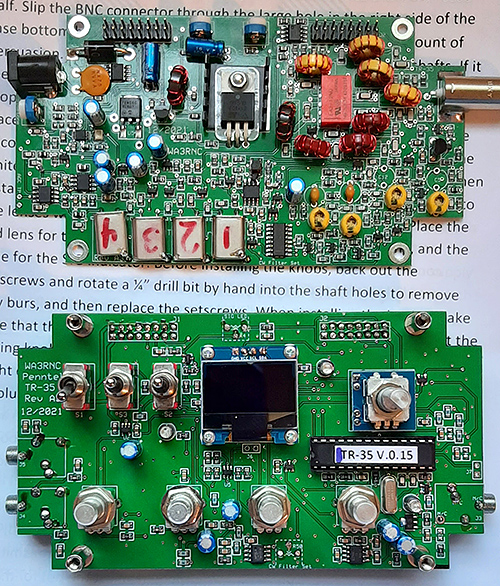
Boards completed. Plenty of room for easy assembly

UPDATE: The TR-35 is reviewed in the December 2022 issue of QST. 

                  .

I've only had the Penntek TR-35 exactly one week, but during that time I've:

and had many ragchews (and park huntings) on all four bands. I've also made selectivity, spectrum and MDS measurements.

Be forewarned - the following may sound like an advertisement, but it is not. I paid full price for the kit and have had no other communication with the kit's designer, John WA3RNC.

Now that that's out of the way, here is a fleshing-out of the notes I took during the week.

The Build

In 40 years of building kits, I've never seen one that is designed to prevent potential problems to the extent of the TR-35.

First off, the kit arrives about 70% pre-built and pre-aligned. Numerous SMD components are already installed and even the tedium of parts inventory has been rendered as mostly unnecessary due to how the parts are packaged. They come in three sleeves - one for each of two boards, plus the final assembly components (knobs, jacks, plugs, etc).

Within each sleeve, the components for each assembly step are each in their individual pocket. There are anywhere from 1 to 5 components per pocket.

Sunday, August 1, 2021

The new POTA rig goes DXing

20m HamStick

My old-school way of activating parks is more fun and I'll continue to operate that way. But, for some locations, shooting a slingshot and fishing line into a tree is gonna draw attention - and sometimes, that's negative attention.

And some places have no convenient trees. Such was the case on my recent trip to Colorado.

The new method is with my resurrected FT-891 and Bioenno 12V 12AH battery. I have HamSticks for 17, 20, 30 and 40 meters. Today's test went well and I learned that:

  • the FT-891 sucks the juice out of a battery so rapidly that the barometric pressure along the Gulf Coast dropped by 20 millibars.
  • a 40m HamStick has a 2:1 SWR bandwidth of only 100 kHz. This means either CW or phone - not both.
  • the FT-891 is a good (not great) CW rig when set up as per N4HNH's video

The benefit: I can operate anywhere that I can park and draw no attention. The disadvantage: no  one comes over to inquire and get a demo of ham radio.

I've gotten into many conversations while operating from picnic tables, some of which resulted in email exchanges with links to the ARRL and other "What is ham radio all about?" types of websites. That won't happen anymore.

This new (for me) type of operation trades the personalization of ham radio for a greater number of places from which to operate and the ability to more quickly get on the air.

This morning I was tuning the 20m HamStick for lowest SWR on CW and heard a very strong CQ. I was very surprised when I heard the callsign: JE1RZR, calling from Tokyo - 7000 mi/11,200 km away. I was even more surprised when Manabu answered me.

Wednesday, March 10, 2021

БЕЛКА-DX

Codewheel not included!
 

The Belka-DX arrived here about three weeks ago from Minsk, Belarus. It is an updated version of the Belka-DSP, both of which were designed by Aleksandr Buevkiy EU1ME. The photo above was inspired by the "spy radio" theme of a review of the older Belka-DSP (link below).

About the price: if you want one of these diminutive and highly capable receivers, you'll have to decide which of three prices you want to pay. At the time of this posting:

All three options include shipping.

I chose Door Number 3, the Belrig option.

Evidently, some people are uncomfortable using their VISA card for international transactions. I have confidence that my bank will support me and therefore had no such worries. My opinion of PayPal (which isn't available in Belarus) is such that I much prefer using my credit card over using PP anyway.

I received my Belka-DX in 11 days. A tracking number was provided one day after I placed the order and I was able to track it from Minsk to New York to Houston.

Sunday, November 24, 2019

CQWW (CW) with the RGO One


I've never been much of a contester. My participation in them has mainly been due to the DX opportunities they provide - or for their unique ability to put a radio through its paces on what amounts to an RF battleground.

Wednesday, August 14, 2019

A few notes on the new SW-3B QRP transceiver


I received my SW-3B QRP CW transceiver several days ago and would like to offer a few details to others who may be interested. A manual is available online here.

The SW-3B has some obvious similarities to KD1JV's MTR-3B - and some significant differences. These differences, in my opinion, distinguish it from being a clone of the MTR-3B - otherwise I would not have bought one.

I have built and owned many of Steve KD1JV's fine rigs in the past, including an MTR-3B, which I sold when I bought a KX2. It was (and is!) a great radio for its intended purpose and I wanted to see how the SW-3B compared.

Monday, October 29, 2018

"SOS to the Rescue"

A few weeks ago I was looking at an old radio magazine from the year of my father's birth - 1936. In it was an ad for a newly published book that caught my eye. Long out of print of course, I wondered if I could find a copy at a reasonable price. Amazon to the rescue! A $25 copy in very good condition was soon on the way.

I don't normally enjoy reading older books - the prose is more formal and can often seems less personal and somewhat stilted to modern readers. Those that I do read, usually first-person accounts of historical events, are read for their information, not for entertainment.

"SOS to the Rescue", written by Karl Baarslag, was published in 1935. It is an immensely enjoyable book, written, for all intents and purposes, in contemporary English. Baarslag was a maritime radio operator in the 1920's and '30's and this book is a collection of maritime disasters that occurred in the first thirty years of radio's infancy, all told from the onboard radio operator's point of view.