Showing posts with label QRP. Show all posts

Friday, October 16, 2026

Interesting QSO's with QRPp'er Alexey RT7O

ZA/AE5X
While making several activations of Alpet e Shqipërisë National Park (AL-0001) in northern Albania earlier this week, I had a total of three QSO's with Alexey RT7O. Each time, Alexey used a different QRPp rig.

A pleasant series of emails followed over the next couple of days as Alexey described and sent photos of the radios he used - all of which he homebrewed.

The receiver in each case was a Malamute transceiver and its antenna consisted of two 41-meter wires running down from a balcony (set at a 90-degree angle to each other) and sloping down toward a tree and a pole.

The transmitting antenna for the rigs described below was a 14 MHz sloper aimed westward.

In my case, the rig in use was a QRP Labs QMX putting 6 watts into a 1/4-wave whip attached to a magnet mount on the roof of my rental car. No ground radials.

I was surrounded by mountains on all sides and didn't know what to expect of my ability to make contacts from an area with no unobstructed horizon in any direction. To my surprise, contacts came fast and furious thanks to the ZA prefix. 

All QSO's were on 20m CW. 

For our first QSO, Alexey was using a  700 mW transmitter - built with two rod tubes - to mark the "First Earth Satellite" activity event:

.


.


.

An audio recording of this QSO is here (I was using a QMX). 

. 

For our next QSO's Alexey used the absolutely beautiful 300mW designed around an old Soviet 6P15P tube. The schematic is shown here:

Friday, October 9, 2026

Activating AL-0001 with the QMX - and a bit of drone flying

Last year, Hans G0UPL rushed me a QMX at my request so that I could operate during an impromptu trip to Vietnam. As it turned out, it was impossible to get permission to operate and I've felt guilty ever since at having taken advantage of Hans' willingness to expedite the QMX.

But as of today the QMX has finally gone on a bit of a DXpedition.

I am currently near Theth Albania and have just returned from activating the unpronounceable-by-me Alpet e Shqipërisë National Park with the QMX.

The entire operation was on 20m CW. I was surrounded by mountains but was able to easily work a good number of Europeans and one US station (K2UPD) in New York. 

The QMX performed well.

I hope to activate the same park from another (better) location tomorrow.


Interesting contacts with QRPp'er Alexey RT7O - click here.

.

. 

Thursday, August 27, 2026

October: ZA/AE5X update

I've been getting a few emails asking for more info on our upcoming trip to Albania.

Thanks to Col at DX World for the image and to Bernie at the Daily DX - and to both of them for publicizing this holiday style operation that will begin in October.

I'd like to emphasize that this is a vacation, not a DXpedition. All radio ops will be a bit on the spur-of-the-moment but I will be able to pre-announce them on my blog and the POTA website a couple hours beforehand.

 
Rig:

Video: QDX-M assists in the rescue of a spelunker

The low-frequency capability of Hans G0UPL's QDX-M proved its worth in Alberta last week.

Rescuers attempting to retrieve a cave explorer made use of a QDX-M built for the 2200 meter band (136 kHz) which, evidently, will allow communications through solid rock.

The rescue was successful and can be read about here:

Calgary Herald

CBC

According to Hans:

"There is a request to make the QDX-M firmware operational down to 88 kHz which is where the UK and European cave rescue services have an allocation. I will try to get that done in the next week or two.

Saturday, June 6, 2026

The set-up of my moto-POTA kit from Davy Crockett SP

A few folks have asked about what I'm using on the road, particularly in regard to the antenna and how it is mounted.

I'm currently taking a day off the ride to wait out the heavy rains due here in central Arkansas which gave me time to put a short video together. 

Back on the sure-to-be-muddy Trail tomorrow. 


Directly on YouTube 


.

. 

Sunday, March 1, 2026

5-band QMX on this morning's 5-band POTA activation

The little QMX has come a long way since it was first released as a CW/digital transceiver, and I don't just mean the addition of SSB.

Far more significant to me are the very recent firmware updates that corrected two major shortcomings with the radio:

Strict DC input voltage limitations and

Common failure of the final BS170's during high SWR at full power.

These two issues prevented the QMX (and QMX+) from being a serious consideration for outdoor ops who don't use resonant antennas and don't want to take along a buck converter, LiPo battery or place "dropping diodes" in series with the DC source.

Those are a lot of things to contend with if you want to just set up and be on the air with minimal fuss.

They are no real issue at all though, if you don't mind taking the time to accommodate the radio rather than have the radio accommodate you.

Sometimes I like to savor the steps necessary to put a station on the air and don't mind taking extra time (and steps) to enjoy the process.

But for a roadtrip like the one I have planned, I want a minimal to-do list and a quick set up time - and I'm happy to say that the QMX/QMX+ now support this.

This morning's was my first activation with the 15-40m QMX. Hans built this one for me and expedited it to me a few months ago as I was trying to get permission to operate in Vietnam and Thailand. Thailand said 'Yes" but Vietnam said "No, don't even bring a radio here". So I had to leave the radio at home since VN was our first stop.

Now, with a different type of trip on the horizon, the little QMX again has become the front runner of the 4 radios I'm considering. 

Wednesday, February 25, 2026

KX2's internal battery capacity when charged from different voltage sources - and a new product for the KX2

The manual for the KX2's internal battery charger (KXIBC2) allows for a variety of input voltages, up to a maximum of 15V, to be used to charge the radio's 2.6AH lithium battery. The manual also mentions that lower voltages (down to 11V) can also be used although the battery will not be fully charged at these voltages.

I was curious to see how a lower charging voltage - ie, a partial charge - would correspond to capacity.

My main interests were:

  • If I charge the KX2's battery from my motorcycle's lead-acid battery, how much capacity will it have?
  • If I charge a completely discharged KX2 battery from the motorcycle, will I still have enough juice in the motorcycle battery to be able to start the bike?

Tuesday, February 3, 2026

Hilltopper Tallboy: Building, aligning, testing and on the air


I've had a hankering to build something lately and happened across a relatively new offering from the 4 States QRP Group: the Hilltopper Tallboy, a monoband QRP CW transceiver kit.

Available for 15 to 40 meters (and maybe 60m soon), I ordered a 20m version. It arrived 5 or 6 days later and I started building it right away.

The Build 

The kit's contents were well organized as were the accompanying instruction.

Parts are sorted into one of 10 bags and the assembly follows the bag's numerical sequence. There are exceptions to this as parts are sometimes required from the ESD bag or the bag containing the matched crystals.


The largest bag - and the one responsible for my initial impression of "Man, that's a substantial kit!" - is the one containing the mechanical components: knobs, jacks, hardware, etc.

Tuesday, May 13, 2025

QRP reviews for QRP rigs


An interesting concept from WD4ELG: a very brief summary of various QRP rigs. The Good and the Bad of each, distilled down to the minimum, by various QRPers:


FT-817ND biggest positive: shack in a box. I did Satellites, SSB, CW, digital (with Signalink), FM. Listened to air band and police band. It is rugged. I worked DX from the car. It was my go-anywhere rig.
FT817ND biggest negative: you really need the CW filter. And the SOTA SSB modulation enhancer. And it was getting long-in-the-tooth.

IC-705 biggest positive - SDR shack in a box. Think 7300 in a portable size, plus bluetooth and Wifi. CW paddle and the included microphone, and you are ready to rock and roll. I use it in shack daily, and can take it to a local park.
IC-705 biggest negative - it is the largest rig. Possibly most fragile. I'm not taking it anywhere unless I have it protected in a backpack.

Penntek TR-35 biggest positive - everything from the front panel without menus!
Penntek TR-35 biggest negative - limited bands, won't work if battery is below 10V.

QMX biggest positive - Hans is a genius. SDR QRP rig now with SSB, for $150! Menus are intuitive.
QMXbiggest negative - so many options and capabilities, I need my cell phone to keep a local copy of the manual.

Tuesday, December 3, 2024

Video: QMX+ receiver sensitivity comparison with KX2, FT-891


Receiver sensitivity of the QRP Labs QMX+ is currently being discussed on the QRP Labs forum with at least one member of the group is disappointed that the MDS value of the QMX+ isn't published.

With the QMX+ being a kit, any published value of MDS would have to be a range of fluid values since receiver characteristics will depend, not only on component tolerance deviations, but of builder's methods in soldering and the winding of toroids & transformers.

I decided to compare my QMX+ receiver sensitivity with the KX2 and FT-891, using a TinySA Ultra and appropriate attenuation.

As can be seen in the video below, the QMX+ does quite well.

After the video, I "measured" (by ear) the point at which a signal becomes too weak to copy on the other bands. The CP1 directional coupler does not cover 6 meters but I measured -113 dBm on that band, which is probably inaccurate. I will sweep the coupler on 6m with my VNA and post a corrected value soon.

Directly on YouTube


.

.

Monday, November 18, 2024

Video: As much DX as domestic! POTA with the QMX+

The Crystal River area of west-central Florida contains several POTA sites within a small area. Crystal River Preserve State Park is my favorite for activations due to the covered picnic table and proximity to manatee-rich waterways.

Kayaks can be rented at the park but my purpose today was to exercise the QMX+ on the high bands and the bands did not disappoint. Contacts were made on all 5 bands 10-20 meters, including a good amount of EU DX and one station in Chile.

Several people have told me that previous videos that include text overlays of the callsigns being heard are helpful so I've included those in the video below. CW speed of myself and most callers is around 22 wpm.


Directly on YouTube


.

.

Saturday, September 28, 2024

Video: A test of M0JKS's aftermarket mic for KX2/KX3 radios

Tom M7MCQ recently posted some interesting info on an aftermarket mic for Elecraft KX-series radios.

The mic was initially offered by Dave M0JKS as a kit but they now are sold completely built.

I ordered one the next day.

Friday, September 27, 2024

QRP rigs, pricing, and what's missing from most of them


A search of the mythical Ideal QRP Travel Rig For Vibration-Rich Environments has me, once again, pondering what's out there and coming to the same old conclusion:

That the Elecraft KX2 - manyyears (yes, one word) after its introduction - still has no peer. Eight years old now - a virtual eternity.

Like others, I watch the YouTube infomercials of the latest offerings, hoping to find my unicorn. But lately, rather than compelling me to open my wallet, they reaffirm the value of the radio released back in 2016.

Here's where I'm coming from vs. what's out there - a bit of a backstory (please bear with me):

Nine years ago, I rode most of the off-road motorcycle trail known as the TAT that stretched (at the time - it's longer now) from Tennessee to Oregon, on a single-cylinder Suzuki DR650. Single-cylinder bikes are often called "thumpers" for good reason. I made it to Utah before the obligations of still being employed called me home. That fact bugs me like you have no idea. I almost finished - but didn't.

I had two radios with me: an MTR-3 and an Elecraft KX2. Both performed admirably and survived single-cylinder vibration and the bike being dropped three times on Colorado's Ophir Pass.

Friday, June 21, 2024

Video: Iceland by drone and operating as TF/AE5X


I am amazed at the stunning scenery of Iceland - the trip was bucket-list incredible.

The video below is about 2/3 drone video (followed by 1/3 radio) of the places we saw as we drove around the country.

In all, we put 950 miles (1500km) on the car and I activated 4 parks. Each park was a first-activation for that park. I had no trouble making contacts but my time at each park was limited. The KX2 at ten watts into a roof-mounted vertical worked well and was portable enough to travel with easily.

Thursday, June 13, 2024

Today's park activation from Iceland

I've activated two parks in Iceland since arriving 4 days ago - both times were first activations for those parks. It's been tough to put the camera down. Iceland is an amazing country and I'll have more to say about it later.

Today's activation of IS-0092 Blábjörg Natural Monument was a lesson in Exceeded Expectations 101. Just when you think you can predict certain aspects of this radio stuff, the unexpected happens.

The park is located near the small town of Djúpivogur on Iceland's eastern coast. It's pretty much a straight shot into parts of Europe but many mountains block the path to the US...or so I thought.

I called CQ POTA on 15, 17 and 20 meters and worked both continents on all bands.

Many US stations were quite strong and I worked a number of familiar calls. The QRN that I worried about was non-existent - the bands are quite, propagation over salt water works like a charm and my 10 watts was doing the trick.

Friday, March 22, 2024

A few thoughts on the QMX transceiver


A recent get-together of Central Florida POTA ops, led, of course, by Bill N4NYM, allowed me the opportunity of meeting a dozen or so kindred spirits at Lake Louisa State Park where I very much enjoyed seeing their set-ups and eating their food.

One of those in attendance was a newbie CW op, Glenn KO4NTA, and somehow Glenn and I got to talking about QRP. He had several rigs with him but the radio he most wanted to show me was his new Army-green (tr)uSDX.

"It costs about $100, covers 5 bands and is super tiny!"

That very statement - since it applies equally - got me to thinking about my inbound QMX, and I asked Glenn if he'd heard of it.

To my surprise, he had not heard of QRP Labs at all.

At that point, I think I may have unwittingly become a bit of a salesman. Glenn had not yet been on the air with his (tr)uSDX and I had not yet been on the air with a QMX. I do have a (tr)uSDX though, and have made a number of hard-won contacts with it on both CW and SSB.

I know the shortcomings of the (tr)uSDX and, now that I've made almost 100 contacts (and two POTA activations) with my new QMX, I have a pretty good idea of where it stands in the $100-Rig Department.

Tuesday, November 15, 2022

Tale of two spectrum analyzers: tinySA vs. Rigol DSA-815, looking at IC-705 IMD

After yesterday's IMD measurements of the (tr)uSDX, I decided to have a look at the IC-705's IMD characteristics with two spectrum analyzers: a Rigol DSA-815 and the tinySA.

More than anything else, this comparison seems to help justify the purchase of the upcoming tinySA ULTRA - not that I need much help in that department.

As expected, third order IMD of the IC-705 was about 30dB down from the injected frequencies on both SA's, but...

...with the lowest resolution BW of the tinySA being only 3 kHz, it was unable to distinguish the RF representation of the two audio frequencies, seeing them only as one signal rather than two signals 1200 Hz apart (700 & 1900 Hz).

Sunday, November 13, 2022

Video: transmitter IMD of (tr)uSDX

Updated 14 Nov (see bottom of page)


Kevin KB9RLW has posted an interesting series of videos to YouTube recently, exploring the poor SSB performance of his (tr)uSDX transceiver (beginning with this one).

I'm primarily a CW operator and wasn't too concerned about my (tr)uSDX's SSB performance but Kevin's video's piqued my interest and I decided have a look with my SA and an Elecraft Two-Tone Generator feeding a 700 Hz and a 1900 Hz tone into the mic input of the (tr)uSDX.

The purpose of this test is to measure IMD due to non-linearities in the transmitter. In a perfect world, only those two tones would be transmitted.

Monday, February 21, 2022

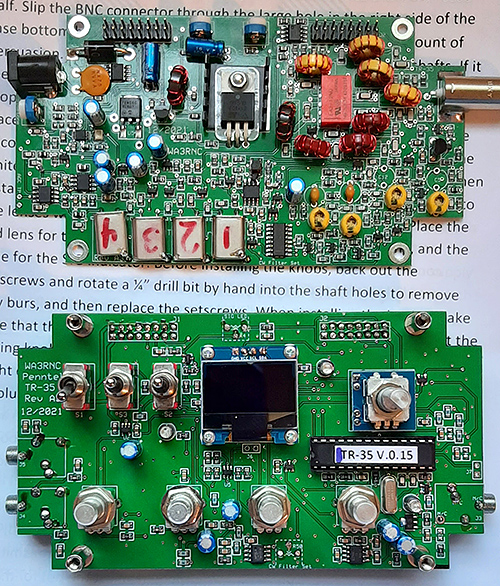
Thoughts on the Penntek TR-35 QRP transceiver kit

Boards completed. Plenty of room for easy assembly

UPDATE: The TR-35 is reviewed in the December 2022 issue of QST. 

                  .

I've only had the Penntek TR-35 exactly one week, but during that time I've:

and had many ragchews (and park huntings) on all four bands. I've also made selectivity, spectrum and MDS measurements.

Be forewarned - the following may sound like an advertisement, but it is not. I paid full price for the kit and have had no other communication with the kit's designer, John WA3RNC.

Now that that's out of the way, here is a fleshing-out of the notes I took during the week.

The Build

In 40 years of building kits, I've never seen one that is designed to prevent potential problems to the extent of the TR-35.

First off, the kit arrives about 70% pre-built and pre-aligned. Numerous SMD components are already installed and even the tedium of parts inventory has been rendered as mostly unnecessary due to how the parts are packaged. They come in three sleeves - one for each of two boards, plus the final assembly components (knobs, jacks, plugs, etc).

Within each sleeve, the components for each assembly step are each in their individual pocket. There are anywhere from 1 to 5 components per pocket.

Saturday, March 13, 2021

Video: The Belka-DX micro-receiver on external antennas

Apologies for the lackluster editing. I chose content over form, hoping to provide a glimpse of what it's like to tune around the bands with this little radio hooked up to something other than the small whip antenna that comes with it.

The high bands, as we know, have been circling the drain for a while now - not much there that I could find - so this is an "AM broadcast band to 14 MHz" test on CW, SSB and AM.

The rest of the video's description is given in the opening 15 seconds. The lighting gets better (a relative term) 3 minutes in.


.

.